Endarterectomy of carotids with acupunctural analgesia. A case report
Keywords:
Carotid Endarterectomy; Acupuncture analgesia; Transient ischemic attack.Abstract
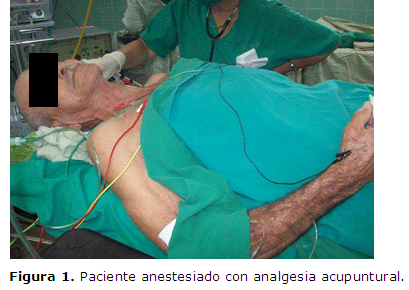
Carotid disease increases the risk of having the most common brain-ischemic stroke significantly. The elevated brain ischemic processes havig their origin in lesions caused by stenosis (ulcerous o non-ulcerous) of the extracranial arteries, mainly in the carotid bifurcation are well-known. As these lesions are surgically accessible, for long years the routine treatment is the Endarterectomy of carotids. The analgesic effect of the acupuncture permits any types of surgery in the chosen anatomic region, preserving mental lucidity in patient, something very significant to determine the patients needing intraluminal shunt after campling the arteries during this surgical procedure. Aimed at associating these criteria, a 76-year-old-male patient who had suffered from four ischemic brain strokes as a consequence of a complicated atheromatous plaque and stenosis of left carotid bifurcation, an Endarterectomy of carotids with acupunctural analgesia was performed without trans-operative or post-operative complications, therefore it is proposed as a logic, economic and secure alternative to remove the carotid obstruction.Downloads
References
1. Silva Sieger F, Arenas Borda W, Zarruk Serrano JG. Factores asociados con enfermedad cerebro vascular isquémica. Rev. de NeurologÃa. Marzo, 2007; 44(5): 259-264.
2. Dobson Ej, Featherstone Rl, Bonati Lh, Vander Worp HB, et al. Carotid artery stenting compared with endarterectomy in patients with symptomatic carotid stenosis (International Carotid Stenting Study): an interim analysis of a randomised controlled trial. Lancet. [Internet] 2010; 375: 985-997. [citado 5 de abril de 2013]. Disponible en: http://www.ncbi.nlm.nih.gov/pmc/articles/PMC2755037/
3. Bond R, Rerkasem K, Naylor R, Rothwell PM. Diferentes tipos de parches para la angioplastia carotÃdea con parches. [Internet] 2010. [citado 5 de abril de 2013]. La Biblioteca Cochrane Plus[internet]. 2013[citado marzo 2013]; 5: Disponible en: http://www.update-software.com/BCP/BCPGetDocument.asp?DocumentID=CD000071
4. Jiménez E, Oteros R, Delgado F, Cano A. Manejo actual de la estenosis de carótida: Tratamiento endovascular comparado con endarterectomÃa. Revista Chilena de RadiologÃa. [Internet]. 2012[citado 5 de abril de 2013];18(2): 49-57. Disponible en: http://www.scielo.cl/pdf/rchradiol/v18n2/art03.pdf
5. Ballesteros Pomar M, Peña Cortés R, Alonso Argüeso G, Ortega MartÃn J.M, Fernández Morán C, Vaquero Morillo F. SÃndrome hiperperfusión cerebral: ¿complicación infrecuente de la endarterectomÃa carotÃdea?. AngiologÃa [Internet]. 2011[citado 5 de abril de 2013]; 63(5):193-199. Disponible en: http://www.elsevier.es/es/revistas/angiologia-294/sindrome-hiperperfusion-cerebral-complicacion-infrecuente-endarterectomia-carotidea-90034949-originales-2011
6. Villarreal Careaga J, Murillo Bonilla L, Góngora Rivera F, Leyva Rendón A, Barinagarrementeria F, et al. GuÃa clÃnica para el tratamiento quirúrgico (endarterectomÃa) y endovascular (angioplastia con protección distal y colocación de stent) para la prevención secundaria de la isquemia cerebral asociada a enfermedad ateroesclerosa carotÃdea. Revista de Investigación ClÃnica [Internet]Marzo-Abril 2010; 62(2): 170-180[citado 5 de abril de 2013]. Disponible en: http://www.medigraphic.com/pdfs/revinvcli/nn-2010/nn102k.pdf
7. Pagola Bérger V. Historia de la analgesia quirúrgica acupuntural. En: Analgesia Quirúrgica Acupuntural. México: Editorial Herbal, 2005. p. 4-20
8. Pagola Bérger V, Llovera RodrÃguez JL, Pérez Borges N. La Analgesia Quirúrgica Acupuntural en cirugÃa del cuello y cara. Medicentro [Internet]. 2006 [citado 5 de abril de 2013]; 10(4): [aprox.5p]. Disponible en: http://www.sld.cu/galerias/pdf/sitios/mednat/la_analgesia_quirurgica_acupuntural_en_la_cirugia_del_cuello_y_la_cara.pdf
9. Marquardt L, Geraghty OC, Mehta Z, Rothwell PM. Low Risk of Ipsilateral Stroke in Patients With Asymptomatic Carotid Stenosis on Best Medical Treatment. A Prospective, Population-Based Study. Stroke. [Internet] 2010; 41(1): e11-17. [citado 5 de abril de 2013]. Disponible en: http://stroke.ahajournals.org/content/41/1/e11.full
10. Field TS, Benavente OR. Current status of antiplatelet agents to prevent stroke. Curr Neurol Neurosci Rep. 2011; 11(1): 6-14.
11. Palacios RJM y cols. Angioplastia carotÃdea con stent en un centro hospitalario de México. Resultados y seguimiento a largo plazo. Revista Mexicana de CardiologÃa.Enero - Marzo 2011; 22(1):10-16
12. Brott TG, Hobson RW , Howard G, Roubin GS, Clark WM et al. The CREST Investigators. Stenting versus Endarterectomy for Treatment of Carotid-Artery Stenosis. N Engl J Med [Internet]. 2010 [citado 5 de abril de 2013]; 363: 11-23. Disponible en: http://www.nejm.org/doi/full/10.1056/NEJMoa0912321
Published
How to Cite
Issue
Section
License
Authors who have publications with this journal agree to the following terms: Authors will retain their copyrights and grant the journal the right of first publication of their work, which will be publication of their work, which will be simultaneously subject to the Creative Commons Attribution License (CC-BY-NC 4.0) that allows third parties to share the work as long as its author and first publication in this journal are indicated.
Authors may adopt other non-exclusive license agreements for distribution of the published version of the work (e.g.: deposit it in an institutional telematic archive or publish it in a volume). Likewise, and according to the recommendations of the Medical Sciences Editorial (ECIMED), authors must declare in each article their contribution according to the CRediT taxonomy (contributor roles). This taxonomy includes 14 roles, which can be used to represent the tasks typically performed by contributors in scientific academic production. It should be consulted in monograph) whenever initial publication in this journal is indicated. Authors are allowed and encouraged to disseminate their work through the Internet (e.g., in institutional telematic archives or on their web page) before and during the submission process, which may produce interesting exchanges and increase citations of the published work. (See The effect of open access). https://casrai.org/credit/