Presence of hepatitis B surface antigen in blood donors
Keywords:
Hepatitis B; Surface antigens; Blood donors.Abstract
Introduction: hepatitis B is considered an important public health problem all over the world, due to the ample geographic distribution and high number of chronic carriers.Objective: to demonstrate the association of hepatitis B virus with risk factors such as: age, race, surgical interventions, sexual preference, tattoos and dental treatment.
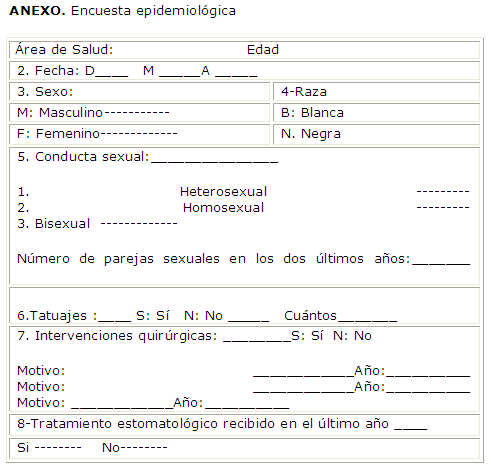
Material and method: a longitudinal, applied and prospective study was conducted with blood donors in Sandino municipality from September 2010 to August 2011; an epidemiological survey was applied along with hepatitis B surface antigen performed to a sample of 1420 donors.
Results: 18 positive hepatitis B surface antigen were found (1,3%), ages from 18-34 (45,2%) and Caucasian race prevailed (60,2%), the 80,7% had no surgical interventions, the sexual preference was heterosexual(99,3%) and those not having tattoos predominated with 99,3%. Regarding the last dental treatment, the group who did not undergo this treatment was more representative 67,2% finding a statistical significant difference.
Conclusions: blood donors presented a high prevalence of hepatitis B virus in Sandino municipality, where no association was found among age, race, surgical interventions, sexual preference, tattoos and the onset of hepatitis B. On the contrary, a relationship between hepatitis B and dental treatment was found.
Downloads
References
1. González Valverde FM, Gómez Ramos MJ, Méndez Martínez M, Rodenas Moncada FJ, Candel Arenas MF, Albarracín Marín-Blázquez A. Evaluación y mejora del cumplimiento de la normativa sobre consentimiento informado para la transfusión de hemoderivados en un servicio de cirugía general. Rev Calidad Asistencial[internet]. 2008[citado octub.2012]; 23(3):142-4. Disponible en: http://www.elsevier.es/es/revistas/calidad-asistencial-256/evaluacion-mejora-cumplimiento-normativa-consentimiento-informado-transfusion-13123005-cartas-al-director-2008
2. Cabezas Sánchez C. Situación y control de la hepatitis B y Delta en el Perú. Acta méd. Peruana[internet]. 2008[citado octub.2012]; 25(2). Disponible en: http://www.scielo.org.pe/scielo.php?script=sci_arttext&pid=S1728-59172008000200010
3. Gámez Pérez A.Cuba: Un escenario particular para brindar lisado plaquetario alogénico a partir de sangre segura. Rev Ciencias Médicas Pinar del Río[internet]. 2011[citado octub.2012];15(4). Disponible en: http://scielo.sld.cu/scielo.php?pid=S1561-31942011000400002&script=sci_arttext&tlng=en
4. Rupp R, Rosenthal S, Middleman A. Vaccination: An Opportunity to Enhanc Early Adolescent Preventive Services. Journal of Adolescent Health[internet]. 2006[cited octub.2012]; 39:461-464. Disponible en: http://www.sciencedirect.com/science/article/pii/S1054139X06001340
5. Ibarra H. Cambios en la epidemiología de las hepatitis virales en Chile y consideraciones en estrategias de prevención. Rev Méd Chile[internet]. 2007[citado octub.2012]; 135: 229-39. Disponible en: http://www.scielo.cl/scielo.php?pid=S0034-98872007000200013&script=sci_arttext
6. Álvarez Castelló M, Pérez Gómez Y, Domínguez Morales RB. Importación de hemoderivados en Cuba. Necesidad de su regulación. Rev Cubana Hematol Inmunol Hemoter[internet]. 2008[citado octub.2012]; 24(3). Disponible en: http://www.bvs.sld.cu/revistas/hih/vol24_3_08/hih01308.htm
7. Mateo de Acosta AD, Porres Aguilar M, Vázquez Saldaña DG, Makipour JrJ, Bedolla E. Actualización bibliográfica sobre el uso de preparaciones ricas en plaquetas en la cicatrización de heridas. Cir. plást. iberolatinoam[internet]. jul.-sep.2010[citado nov.2011]; 36(3): Disponible en: http://scielo.isciii.es/scielo.php?pid=S0376-78922010000300005&script=sci_arttext
8. Rivero R. Transmisión de infecciones virales por la transfusión de sangre. Rev Cubana Hematol Inmunol Hemoter. [online]. 2006[citado octub. 2012]; 22(2): Disponible en: http://scielo.sld.cu/scielo.php?script=sci_arttext&pid=S0864-02892006000200002&lng=es.
9. Devesa M, Pujol FH. Virus Res. Hepatitis B virus genetic diversity in Latin America. 2007[cited octub.2012]; 127(2): 177-84. Disponible en: http://www.sciencedirect.com/science/article/pii/S0168170207000056
10. Diarra A, Kouriba B, Baby M, Murphy E, Lefrere JJ. HIV, HCV, HBV and syphilis rate of positive donations among blood donations in Mali: Lower rates among volunteer blood donors. Transfus Clin Biol[internet]. 2009[cited octub. 2012]; 16(5-6): 444-7. Disponible en: http://linkinghub.elsevier.com/retrieve/pii/S1246782009001554?via=sd
11. Manzini P, Girotto M, Borsotti R, Giachino O: Italian blood donors with anti-HBc and occult hepatitis B virus infection. Haematologica[internet]. 2007[cited octub. 2012]; 92(12): 1664-1670. Disponible en: http://haematol.highwire.org/content/92/12/1664.short
12. Monsalve-Castillo F, Echevarría JM, Atencio R, Suárez A, Estévez J, Costa-León L, Montiel P, Molero T, Zambrano M. Alta prevalencia de la infección por el virus de hepatitis B en la comunidad indígena Japreira, estado Zulia, Venezuela. Cad Saúde Pública[internet]. 2008[citado octub. 2012]; 24(5): 1183-1186. Disponible en: http://www.scielosp.org/pdf/csp/v24n5/28.pdf
13. Sánchez Frenes P, Sánchez Bouza M. Veinte años de contribución a la salud de los cienfuegueros: Un enfermero cubano de todos los tiempos. MediSur[serial on the Internet]. 2009 Apr [cited 2013 enero 11]; 7(2): 78-79. Available from: http://scielo.sld.cu/scielo.php?script=sci_arttext&pid=S1727-897X2009000200013&lng=en.
14. Navarro D, Panchuck P, Villalba Salinas V, Salaza M, Merino S, Balbachán S. Hepatitis B, C y en coinfección con VIH en un Banco de Sangre en Corrientes, Argentina. Rev Cubana Med Trop[internet]. 2008[citado octub.2012]; 60(2). Disponible en: http://scielo.sld.cu/scielo.php?pid=S0375-07602008000200012&script=sci_arttext
15. Pereira A, Valenzuela MT, Mora J, Vera L. Situación actual de la Hepatitis B en Chile. Rev.méd.Chile[internet]. 2008[citado octub.2012]; 136(6). Disponible en: http://www.scielo.cl/scielo.php?pid=S0034-98872008000600006&script=sci_arttext&tlng=pt
16. Liu Y, Liu X, Kuang J. Comparing inmunogenicity and efficacy of two vaccination hepatitis B vaccines in newborn infants of hepatitis B surface antigen (+)/hepatitis B e antigen (+) carrier mothers. Zhonghua Fu Chan Ke Za Zhi[internet] 2006[cited octub. 2012]; 34(8): 470-2. Disponible en: http://www.bmj.com/content/332/7537/328
17. Pozo E, Chaparro M, Padrón A. Seroprevalencia de Hepatitis B en donantes de sangre de la Ciudad de Maracaibo, Estado Zulia: Periodo 2000-2005. Kasmera [revista en la Internet]. 2007 Jun [citado 2013 enero 11]; 35(1): 49-55. Disponible en: http://www.scielo.org.ve/scielo.php?script=sci_arttext&pid=S0075-52222007000100006&lng=es.
18. Keefe EB, Dieterich Pawlotsky JM, et al. Chronic hepatitis B; preventing, detecting and managing. Viral Clin Gastr[internet]. 2008[cited octub. 2012]; 6(5): 268-274. Disponible en: http://www.sciencedirect.com/science/article/pii/S1542356507012463
19. Valenzuela MT. Importancia de las vacunas contra los virus de las hepatitis A y B en Chile. Rev. méd. Chile[internet].2009[citado octub. 2012]; 13(6). Disponible en: http://www.scielo.cl/scielo.php?script=sci_arttext&pid=S0034-98872009000600017
20. Neaigus A, Gyarmanthy VA, Millar M, et al. Injecting and sexual risk correlates of HBV and HVC seroprevalence among new drug injectors. Drug Alcohol Depend[internet]. 2007[cited octub. 2012]; 89(2-3): 234- 43. Disponible en: http://www.ncbi.nlm.nih.gov/pmc/articles/PMC1947004/
21. Agurto H, Lama J, Suarez L, Montano S, et al. Epidemiología y factores de riesgo asociado para HBsAg entre hombres que tienen sexo con hombres en el Perú. Congreso Peruano de Enfermedades Infecciosas y Tropicales. Lima: Sociedad Peruana de Enfermedades Infecciosas y Tropicales; 2007.
22. Machado-Carvalhais HP, Martins TC, Ramos-Jorge ML, Magela-Machado D, Paiva SM, Pordeus I A. Management of occupational bloodborne exposure in a dental teaching environment. J Dent Educ[internet]. 2007[cited octub. 2012]; 71: 1348-55. Disponible en: http://www.jdentaled.org/content/71/10/1348.short
Published
How to Cite
Issue
Section
License
Authors who have publications with this journal agree to the following terms: Authors will retain their copyrights and grant the journal the right of first publication of their work, which will be publication of their work, which will be simultaneously subject to the Creative Commons Attribution License (CC-BY-NC 4.0) that allows third parties to share the work as long as its author and first publication in this journal are indicated.
Authors may adopt other non-exclusive license agreements for distribution of the published version of the work (e.g.: deposit it in an institutional telematic archive or publish it in a volume). Likewise, and according to the recommendations of the Medical Sciences Editorial (ECIMED), authors must declare in each article their contribution according to the CRediT taxonomy (contributor roles). This taxonomy includes 14 roles, which can be used to represent the tasks typically performed by contributors in scientific academic production. It should be consulted in monograph) whenever initial publication in this journal is indicated. Authors are allowed and encouraged to disseminate their work through the Internet (e.g., in institutional telematic archives or on their web page) before and during the submission process, which may produce interesting exchanges and increase citations of the published work. (See The effect of open access). https://casrai.org/credit/