Pesquisaje de afecciones oculares en niños de círculos infantiles. Estrategia de intervención
Palabras clave:
Oftalmopatías; Ambliopía; Preescolar.Resumen
Introducción: cuando la visión está disminuida o ausente provoca minusvalías para los niños, provocando trastornos del aprendizaje y de su desarrollo integral.
Objetivo: determinar las afecciones oculares en niños de círculos infantiles.
Material y método: se realizó una investigación longitudinal, aplicada y de intervención mediante pesquisa activa durante los años 2010-2011. El universo estuvo constituido por los 367 niños de 1 a 6 años de los Círculos Infantiles del Policlínico “Turcios Lima” de Pinar del Río. La muestra estuvo representada por 42 niños, realizada mediante muestreo intencional. Se les realizó una encuesta estructurada y una historia clínica oftalmológica a los niños que cumplieron los criterios de inclusión. La información recogida se procesó, utilizando el sistema Epi Info, calculándose las frecuencias absolutas y relativas porcentuales, la media y la desviación estándar, así como el estadígrafo Ji cuadrado al 95 % de certeza.
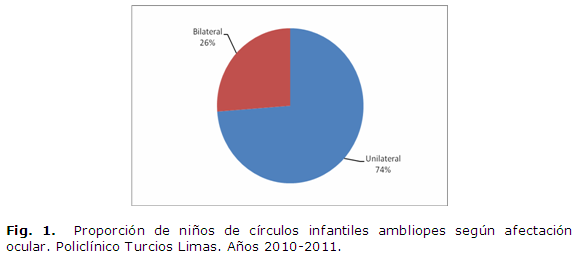
Resultados: la prevalencia de niños con afecciones oculares fue del 11,4%, diagnosticándose el 61,9% por vez primera, independientemente de la edad y el sexo. Prevaleció la afectación ocular unilateral, de severidad ligera, causada por trastornos refractivos. En la medida que aumentó la escolaridad de los padres se incrementaron sus conocimientos sobre las enfermedades oculares.
Conclusiones: existe un subregistro de afecciones oculares en los niños pesquisados, a pesar del examen oftalmológico que se realiza a la entrada de estas instituciones. El trabajo del oftalmólogo y del equipo de salud de la APS, contribuye a la eliminación de la ambliopía, logrando una mejor calidad de vida, y una adecuada capacidad intelectual y de aprendizaje.
Descargas
Citas
1. Ríos TM, Capote CA, Padilla GC, Eguía MF, Hernández SJR. Oftalmología. Criterios y Tendencias Actuales. La Habana: Ecimed; 2009, p.727-732. [Citado Ene 2012]: Disponible en: www.imbiomed.com.mx/1/1/articulos.php?...id...
2. Ministerio de Salud Pública de Cuba. Anuario estadístico de Salud 2010. La Habana: MINSAP; 2010. [Citado Ene 2012]: Disponible en: www.infomed.sld.cu/
3. Kanski JJ. Oftalmología Clínica. 5ta ed. Madrid: Editorial Elsevier; 2004, p.733-745. [Citado Ene 2012]: Disponible en:librosdeciencias.blogspot.com/.../oftalmologia-clinica-jack-j-kanski.h...
4. Eguía Martínez F, Río Torres M, Capote Cabrera A. Manual de diagnóstico y tratamiento en Oftalmología. La Habana: Editorial Ciencias Médicas; 2009, p. 201-2. [Citado Ene 2012]: Disponible en: scielo.sld.cu/scielo.php?pid=S0034-75312010000300004...sci...
5. Palmero Aragón EY, Rodríguez Montero P, Triana Gutiérrez RC. Estudio de ametropías en la escuela primaria Federico Engels del municipio Sancti Spíritus. Revista Infociencia [Revista en la Internet]; 2010; 14(1); [citado Ene 2012]: Disponible en: infociencia.idict.cu/index.php/infociencia/search/titles?searchPage=7.
6. Carrión Ojeda C, Gálvez Quiroz F, Morales de la Cruz J, Guevara Florián V, Jaramillo R, Gazzani Meza M. Ametropía y ambliopía en escolares de 42 escuelas del programa Escuelas Saludables en la DISA II, Lima, Perú, 2007-2008. Acta Méd. Perú. [Revista en la Internet]; 2009; 26(1):17-21. [Citado Ene 2012]: Disponible en: http://scielo.sld.cu/scielo.php?pid=S0034-75312010000300004.
7. Flores Visedo CM. Ambliopía y trastornos de refracción, detección precoz en niños. Pediatr Integral 2009; XIII (7):625-632. [Citado Ene 2012]: Disponible en: www.sepeap.org/secciones/documentos/.../3_%20C_M_ambliopatia.p...
8. García Alcolea EE, Estrada Silega Y, Aparicio Melián A. Frecuencia de ametropías en niños. Rev. Cubana Pediatr [Revista en la Internet]; 2010 Sep; 82(3): 28-37. [Citado Ene 2012]: Disponible en: http://scielo.sld.cu/scielo.php?script=sci_arttext&pid=S003475312010000300004&lng=es.
9. Llerena Díaz AY, Pérez Rodríguez AE. Principales afecciones oftalmológicas en el municipio de Guane, Pinar del Río. Rev. Cubana Oftalmol 2010; 23(1) Ciudad de la Habana ene.-jun. [citado Ene 2012]: Disponible en: scielo.sld.cu/scielo.php?script=sci_arttext...21762010000100012
10. Fernández Rivero C, Payán Echevarría T, Varela Ramos G, González Rodríguez NT. Comportamiento clínico- epidemiológico de las ametropías. AMC 2010; 14(6) Camagüey nov.dic. [Citado Ene 2012]: Disponible en: redalyc.uaemex.mx/src/inicio/ArtPdfRed.jsp?iCve=211116132004
11. Levin AV. Pediatric ophthalmology and strabismus: something for everyone. Curr Opin Ophthalmol. 2010; 21(5):327-8. [Citado Ene 2012]: Disponible en: www.portalesmedicos.com/.../Estrabismo.-Caracteristicas-clinico-...
12. López Torres M, Acosta Rodríguez F, Jalilo Hernández SM. Caracterización clínica epidemiológica demográfica de las enfermedades oculares. San Juan y Martínez. 2006-2007. Rev. Misión Milagro [serie en Internet]. 2009 jul.; 3(3). [citado Ene 2012]: Disponible en: http://www.misionmilagro.sld.cu/vol3no3/inv3306.php
13. Fernández Pérez SR, Dios Lorente JA de, Peña Sixto L, García Espinosa SM, León Leal M. Causas más frecuentes de consulta oftalmológica. MEDISAN [serie en Internet]. 2009; 13(3). [Citado Ene 2012]: Disponible en: http://bvs.sld.cu/revistas/san/vol13_3_09/san10309.htm.
14. Reed G. Visually-impaired Children in Habana: Challenges of Eduactions, Rehabilitation and Inclusion. MEDICC Review, January 2011; 13(1):7-9. [Citado Ene 2012]: Disponible en: www.dtic.co.cu/FTP/informes/df_v_2.6_001_08ci.pdf
15. Pupo Negreira EC, Labrada Rodríguez YH, Verdecía Jacobo K. Rehabilitación visual en niños ambliopes. Rev. Cubana Oftalmol 2009; 22 (2) Ciudad de la Habana jul.-dic. [Citado Ene 2012]: Disponible en: scielo.sld.cu/scielo.php?pid=S0864-21762010000200013...sci...
16. Pérez González H, García Concha Y, Frómeta Suárez I. Principales afecciones oftalmológicas detectadas mediante pesquisaje activo en la población Uruguaya. Panorama Cuba y Salud 2012; 7(1):12-17. [Citado 2013 Oct 18]. Disponible en: http://www.panorama.sld.cu/pdf/v7_no1/articulos_originales/principales_afecciones_oftalmologicas.pdf.
17. Álvarez Díaz MV, Martínez Legón ZC, Triana Casado I, Morell Ochoa Z. Caracterización de las alteraciones oftalmológicas en pacientes con VIH/SIDA. MEDICIEGO 2011; 17(2). [Citado 2013 Oct 18]. Disponible en: http://www.bvs.sld.cu/revistas/mciego/vol17_02_2011/pdf/T11.pdf
18. García Alcolea EE, Herrero Aguirre H, Perdomo Leyva D, Gross Fernández C, Casas Gross S. Evaluación del impacto de la consulta de oftalmología en la atención primaria de salud. MEDISAN [revista en la Internet]. 2010 Oct [citado 2013 Oct 18]; 14(7): 888-903. Disponible en: http://scielo.sld.cu/scielo.php?script=sci_arttext&pid=S1029-30192010000700002&lng=es.
19. Fernández Ragi Rosa María, Toledo González Yusimik, García Fernández Yanet, Rodríguez Rivero Mayling, García Díaz Omar. Retinopatía de la prematuridad en el neonato con peso menor de 1 500 g. Rev Cubana Pediatr [revista en la Internet]. 2010 Mar [citado 2013 Oct 18]; 82(1). Disponible en: http://scielo.sld.cu/scielo.php?script=sci_arttext&pid=S0034-75312010000100003&lng=es.
20. García Alcolea Eglis Esteban, Lahera Cabrales Rebeca. Influencia de la Misión Milagro en la salud visual latinoamericana. Rev Cubana Salud Pública [revista en la Internet]. 2010 Dic [citado 2013 Oct 18] ; 36(4): 382-384. Disponible en: http://scielo.sld.cu/scielo.php?script=sci_arttext&pid=S0864-34662010000400016&lng=es.
Publicado
Cómo citar
Número
Sección
Licencia
Aquellos autores/as que tengan publicaciones con esta revista, aceptan los términos siguientes:- Los autores/as conservarán sus derechos de autor y garantizarán a la revista el derecho de primera publicación de su obra, el cuál estará simultáneamente sujeto a la Licencia de reconocimiento de Creative Commons que permite a terceros compartir la obra siempre que se indique su autor y su primera publicación esta revista.
- Los autores/as podrán adoptar otros acuerdos de licencia no exclusiva de distribución de la versión de la obra publicada (p. ej.: depositarla en un archivo telemático institucional o publicarla en un volumen monográfico) siempre que se indique la publicación inicial en esta revista.
- Se permite y recomienda a los autores/as difundir su obra a través de Internet (p. ej.: en archivos telemáticos institucionales o en su página web) antes y durante el proceso de envío, lo cual puede producir intercambios interesantes y aumentar las citas de la obra publicada. (Véase El efecto del acceso abierto).