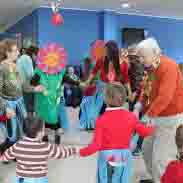
Citizen education for adolescents and the elderly from the community project of Ana la Cub-Ana
Keywords:
PROYECTO; EDUCACIÓN; ACTIVIDAD.Abstract
Introduction: nowadays the system of activities with a systemic and trans-disciplinary approach has a special meaning, as it involves a diversity of scientific perspectives in order to achieve the expected results.
Objective: to develop a system of activities for citizen education of adolescents and the elderly in the community project of Ana la Cub-Ana with a systemic and trans-disciplinary approach at Celso Maragoto Lara community in Pinar del Río municipality.
Method: based on the extra-university activities of Pinar del Rio University of Medical Sciences, the study comprises the universe of inhabitants of the community, its population of old adults and adolescents, with a sample chosen by simple random criterion. Materialistic- dialectic method and others from the theoretical and the empirical levels were used.
Results: the system of activities promoted, along with the improvement of the senior adult program in intergenerational relationships, are based on the design of the project program with a significant appreciation of changes in the behaviors of its members and positive influences on the community development, on the institutions and the population.
Conclusion: through the community work and the extra-university activities of the medical students, scientific and methodological development of the professors involved in this project, together with the enhancement of political- ideological work having a systemic and trans-disciplinary approach, favorable changes of its citizens and the values identified are developed in the community.
Downloads
References
1. Chávez J. (2005). Filosofía de la Educación como disciplina actual del conocimiento teórico y tradición del pensamiento pedagógico. En: Filosofía de la educación (Selección de lecturas). La Habana: Editorial Pueblo y Educación.
2. Castro Ruz, Fidel. Discurso pronunciado por el Presidente de la República de Cuba, en la clausura del Congreso Pedagogía 2003, en el teatro "Carlos Marx", el 7 de febrero del 2003. Disponible en:
http://www.cuba.cu/gobierno/discursos/2003/esp/f070203e.html
3. Morin, Edgar. Articular los saberes: ¿qué saberes enseñar en las escuelas? Ediciones Universidad del Salvador, Buenos Aires. República Argentina. 2006. Disponible en: http://racimo.usal.edu.ar/1595/
4. Centre International de Recherches et EtudesTransdisciplinaires. [citado: 27 de abril de 2017]. Disponible en:
https://www.youtube.com/channel/UCGIfETWVop6uGU0ojYHboBw
5. Addine Fernández, Fátima. “La interacción: núcleo de las relaciones interdisciplinarias en la formación de profesores de perfil amplio. Instituto Superior Pedagógico Enrique José Varona. Soporte magnético. [citado: 27 de abril de 2017]. Disponible en: http://www.redalyc.org/pdf/3606/360635561004.pdf
6. ICCP. Proyecto educativo en la escuela. La Habana. Cuba. 2008. Disponible en: http://www.redalyc.org/pdf/447/44713058018.pdf
7. Fiallo Jorge P: La interdisciplinariedad en la escuela: un reto para la calidad de la educación. ICCP. La Habana 2001, p 59. Disponible en: http://es.calameo.com/books/000233168035d8cebb060
8. Parrilla, Á., & Sierra, S. Construyendo una investigación inclusiva en torno a las distintas transiciones educativas. Revista Electrónica Interuniversitaria de Formación del Profesorado. 2015. 18(1), 161-175. Disponible en: http://revistas.um.es/reifop/article/view/214381
9. Izaguirre Remón R. Un enfoque para la extensión universitaria en la educación médica superior cubana. Congreso Universidad.2015. Vol. IV (3).Disponible en: http://www.congresouniversidad.cu/revista/index.php/congresouniversidad/index
10.Varcasia Era L. Crecen proyectos comunitarios en Cuba. La Revista de la gente. 18 diciembre, 2015. [citado: 27 de abril de 2017] Disponible en: http://www.lacalle.cu/crecen-proyectos-comunitarios/
Published
How to Cite
Issue
Section
License
Authors who have publications with this journal agree to the following terms: Authors will retain their copyrights and grant the journal the right of first publication of their work, which will be publication of their work, which will be simultaneously subject to the Creative Commons Attribution License (CC-BY-NC 4.0) that allows third parties to share the work as long as its author and first publication in this journal are indicated.
Authors may adopt other non-exclusive license agreements for distribution of the published version of the work (e.g.: deposit it in an institutional telematic archive or publish it in a volume). Likewise, and according to the recommendations of the Medical Sciences Editorial (ECIMED), authors must declare in each article their contribution according to the CRediT taxonomy (contributor roles). This taxonomy includes 14 roles, which can be used to represent the tasks typically performed by contributors in scientific academic production. It should be consulted in monograph) whenever initial publication in this journal is indicated. Authors are allowed and encouraged to disseminate their work through the Internet (e.g., in institutional telematic archives or on their web page) before and during the submission process, which may produce interesting exchanges and increase citations of the published work. (See The effect of open access). https://casrai.org/credit/