Congenital spondyloepiphyseal dysplasia
Keywords:
OSTEOCHONDRODYSPLASIAS; CHROMOSOMES; HUMAN; PAIR 12; COLLAGEN TYPE II.Abstract
Introduction: congenital spondyloepiphyseal dysplasia, a type of bone dysplasia manifest from the infancy stage, is caused by mutations in the COL2A1 gene, located on chromosome 12, causing defects in type II collagen, a major component of cartilage. This type of collagen is also found in the vitreous body of the eye and in the intervertebral discs. This disease is characterized by low size to predominance of the thorax, being short by the serious platyspondilia that causes the deformities.
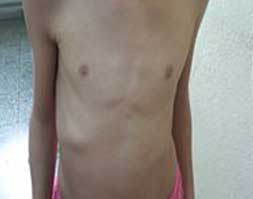
Clinical case: a 12-year-old patient presented a deformity of the lumbar spine from the age of 6 months. It presents low size with thoracic deformity, widening in the joint of elbows and knees. The family was asked to authorize several radiological studies, as well as physical examination and to take photos that would aid in the clinical diagnosis.
Conclusions: Considering the importance of multidisciplinary follow-up between orthopedic, radiologist and clinical geneticist to make a correct diagnosis. Achieving the same thanks to the use of an effective tool, clinical or pattern method. This allowed to offer an adequate monitoring and genetic counseling to this family.
Downloads
References
1. Arita M, Fertala J, Hou C, Kostas J, Steplewski A, Fertala A. Prospects and limitations of improving skeletal growth in a mouse model of spondyloepiphyseal dysplasia caused by R992C (p.R1192C) substitution in collagen II. PLoS One. 2017 Feb 9; [citado 18 Sep 2017] 12(2). Disponible en : https://www.ncbi.nlm.nih.gov/pubmed/28182776
2. Bayhan IA, Abousamra O, Rogers KJ, Bober MB, Miller F, Mackenzie WG. Valgus Hip Osteotomy in Children With Spondyloepiphyseal Dysplasia Congenita: Midterm Results. J Pediatr Orthop. 2017 Jan 30. [citado 18 Sep 2017] Disponible en : https://www.ncbi.nlm.nih.gov/pubmed/28141691.
3. Singh SK, Rajoria K. Ayurvedic management of spondyloepiphyseal dysplasia tarda, a rare hereditary disorder. J Ayurveda Integr Med. 2016 Oct - Dec; [citado 11 Sep 2017]7(4):249-254. Disponible en: https://www.ncbi.nlm.nih.gov/pubmed/27890699.
4. Saigal R, Chaudhary A, Pathak P, Singh A, Gupta D, Tank ML, et al. Spondyloepihyseal Dysplasia Congenita. J Assoc Physicians India. 2016 Jul; [citado 11 Sep 2017]64(7): 85-86. Disponible en : https://www.ncbi.nlm.nih.gov/pubmed/27759355
5. Srivastava P, Pandey H, Agarwal D, Mandal K, Phadke SR. Spondyloepiphyseal dysplasia Omani type: CHST3 mutation spectrum and phenotypes in three Indian families. Am J Med Genet A. 2017 Jan; [citado 18 Sep 2017] 173(1):163-168. Disponible en: https://www.ncbi.nlm.nih.gov/pubmed/27753269.
6. Chung SW, Kang EH, Lee YJ, Ha YJ, Song YW. Three Cases of Spondyloepiphyseal Dysplasia Tarda in One Korean Family. Yonsei Med J. 2016 Sep; [citado 18 Sep 2017] 57(5):1290-3. Disponible en: https://www.ncbi.nlm.nih.gov/pubmed/27401665.
7. Mitra S, Jindal S, Saroa R, Palta S. General anaesthesia for parturients with spondyloepiphyseal dysplasia: Risky but possible! Indian J Anaesth. 2016 Jun; [citado 18 Sep 2017]60(6):435-7. Disponible en: https://www.ncbi.nlm.nih.gov/pubmed/27330211
8. Nakashima Y, Sakamoto Y, Nishimura G, Ikegawa S, Iwamoto Y. A novel type II collagen gene mutation in a family with spondyloepiphyseal dysplasia and extensive intrafamilial phenotypic diversity. Hum Genome Var. 2016 May 19; [citado 18 Sep 2017]3:16007. Disponible en: https://www.ncbi.nlm.nih.gov/pubmed/27274858.
9. Liu L, Pang Q, Jiang Y, Li M, Wang O, Xia W. Novel COL2A1 mutations causing spondyloepiphyseal dysplasia congenita in three unrelated Chinese families. Eur Spine J. 2016 Sep; [citado 18 Sep 2017] 25(9):2967-74. Disponible en: https://www.ncbi.nlm.nih.gov/pubmed/27059630
10. Sangsin A, Srichomthong C, Pongpanich M, Suphapeetiporn K, Shotelersuk V. Whole-exome sequencing reveals a novel COL2A1 mutation in a patient with spondylo-epiphyseal dysplasia congenita. Genet Mol Res. 2016 Mar 11; [citado 18 Sep 2017] 15(1):15017624. Disponible en: https://www.ncbi.nlm.nih.gov/pubmed/26985960
Published
How to Cite
Issue
Section
License
Authors who have publications with this journal agree to the following terms: Authors will retain their copyrights and grant the journal the right of first publication of their work, which will be publication of their work, which will be simultaneously subject to the Creative Commons Attribution License (CC-BY-NC 4.0) that allows third parties to share the work as long as its author and first publication in this journal are indicated.
Authors may adopt other non-exclusive license agreements for distribution of the published version of the work (e.g.: deposit it in an institutional telematic archive or publish it in a volume). Likewise, and according to the recommendations of the Medical Sciences Editorial (ECIMED), authors must declare in each article their contribution according to the CRediT taxonomy (contributor roles). This taxonomy includes 14 roles, which can be used to represent the tasks typically performed by contributors in scientific academic production. It should be consulted in monograph) whenever initial publication in this journal is indicated. Authors are allowed and encouraged to disseminate their work through the Internet (e.g., in institutional telematic archives or on their web page) before and during the submission process, which may produce interesting exchanges and increase citations of the published work. (See The effect of open access). https://casrai.org/credit/